Bricks were made on the southern outskirts of Caernarfon from the mid-19th century until 2008 under the name Seiont, though latterly in the hands of the Butterley Group and Hanson PLC. Unlike other small brickmakers in northwest Wales, the raw clay was not alluvial in origin, but a friable outcrop of Ordovician mudstone. That is in itself a strange feature, since the Nant Ffrancon Formation is elsewhere a very hard, low-grade metamorphic rock famous for producing some of the country’s finest roofing slates.
We decided to put a sample through our laboratory to find what made it special. The problem we faced was that the works had been shut for over a decade and no sampling visit would be permitted by the landowners. Recently an opportunity arose to visit the Caernarfon By-pass construction site, including the quarry, which was producing material for incorporation as a binder in granular fill on embanked sections of the road base. This is the last chance, because the quarry will be closed and landscaped when the job is complete.

“The Seiont Quarry in October 2019 during a visit by NWGA to the Caernarfon By-pass groundworks by invitation of Jones Bros Civil Engineering UK”, image by Lyn Relph.
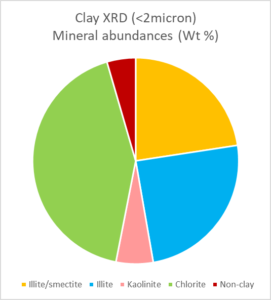
The clay XRD analysis shows that this is not a traditional brick-clay material. Normally, the quality of a ceramic body is inherited from its high content of kaolinite and illite, which convey plasticity and resilience to firing as well as quartz and fine lithic material which give strength to resist shrinkage and deformation during drying and firing. Carbonates in low abundance are tolerable if a paler fired colour is required. Our Seiont clay differs, however. Firstly, the clay weight-fraction is low at 9%, compared with classic brick clays with 25-30%. Secondly, Mg-chlorite makes up almost half of the total clay fraction, with minor kaolinite which is difficult to quantify reliably. The remainder of the clay is a very poorly-crystalline illite and ordered illite/smectite. An unusual feature is a minor peak at 9.5 degrees, apparently due to pyrophyllite.
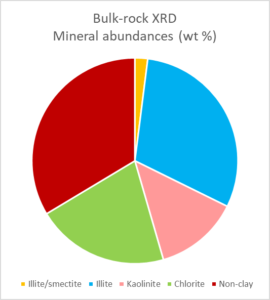
Turning to the bulk-rock sample, the powder diffraction gives us a breakdown of all the minerals present and their abundance. The total of clay minerals is 66% (chlorite 21%, Illite+Illite/smectite 32%, kaolinite 13%), with quartz just 22% and minor siderite. This shows that the great majority of its ‘clay’ minerals have a grain size greater than 2 micrometres, and arguably on this ground, are not clay! The abundant chlorite raises another consideration: is chlorite a ‘clay’ mineral at all? It is not normally considered as such by ceramics specialists, and geological opinion is divided. If chlorite is discounted, the total of clay minerals reduces to 45% and we would need to refer to BS5390 and consider plasticity as a discriminator. The remainder of the bulk sample is pyrophyllite at 10%, which is a bit of a surprise but may hold a clue to our friability issue. Pyrophyllite is a close relative of talc, and forms under hydrothermal conditions through retrograde reactions. Maybe we are looking at an area that has been affected by fluid circulation during the pervasive injection of basaltic dykes through the region during the Tertiary? Either way, there is a hint of processes which have affected these rocks long after their Caledonian metamorphism.