


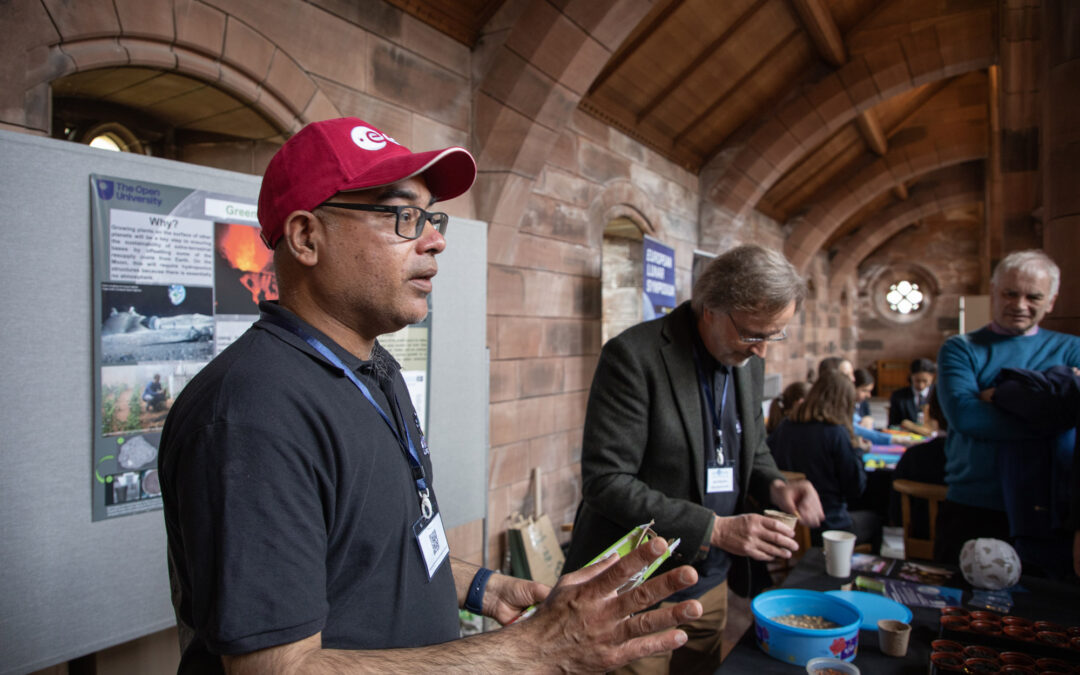
Alan R Butcher gave a talk at the recent Lunar Symposium in Scotland, which was fittingly held near to astronaut Neil Armstrong’s ancestral home in the town of Langholm (Dumfries & Gallaway), and marking the 55 year anniversary since the Apollo 11 landing on the Moon. As well as informing the delegates of Alan’s latest imagery of the first human-collected samples back in July 1969, he showcased new images of lunar breccia meteorites, using a workflow comprising combined multi-scale scanning micro-XRF and low vacuum large chamber SEM-EDS analysis, all work undertaken in collaboration with The Open University (Mahesh Anand), the Geological Survey of Finland (Ester Jolis, Sari Lukkari & Ian Corfe), and Bruker Berlin (Andrew Menzies).
planting seeds in lunar analogue soils
This collaboration between Hafren Scientific and The Open University also forms part of a bigger aspiration – to bring technologies originally designed to travel on rockets into Space, back down to Earth. Examples include the microwave treatment of ores and tailings exploration for enhanced extraction of metals, using technology that was designed originally for water and oxygen extraction from the Moon’s regolith, followed by 3D printing of habitats.
For more details see: https://sservi.nasa.gov/els2024/