X-ray Mineral Services (XMS) recently conducted comprehensive analytical work on Estonian phosphorite to characterise its mineralogy, chemistry and texture with lab based and portable equipment.
Estonian phosphorite was comprehensively characterised using XMS’s META workflows. The META workflows are designed to provide complete Mineralogical, Elemental, and Textural Analysis on a wide range of geomaterials in the lab and in the field.
This study utilized x-ray diffraction (XRD), Inductively Coupled Plasma (ICP), Wavelength Dispersive (WD-XRF), and Energy Dispersive x-ray fluorescence (ED-XRF), Fourier Transform Infrared (FTIR) and automated mineralogy (in this example AMICS) techniques.
The mineralogy of the Estonian phosphorite was determined by XRD with Rietveld quantification using AutoQuan software. Automated mineralogy was performed to characterize not only the texture of the phosphorite, but also minerals with abundance lower than the detection limit of XRD (approx. 2%). The mineralogy and texture are characterized by predominant elongated phosphatic (apatite) brachiopod shell fragments, along with detrital quartz and a dolomite cement.
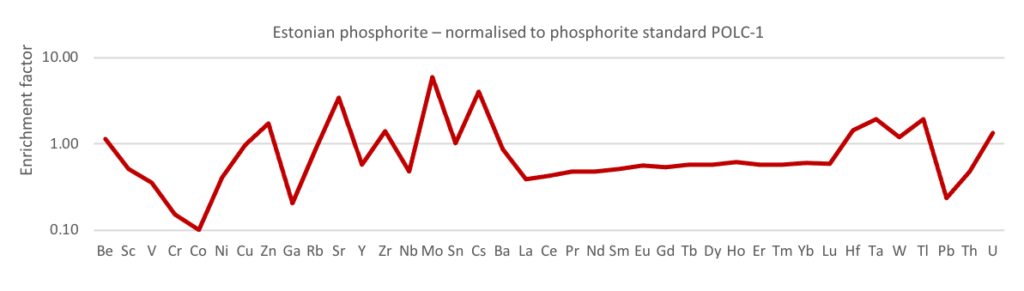
ICP and XRF data were used to characterise the geochemical composition of the phosphorite, and the data was modelled using spider diagrams to highlight elemental enrichments against standard reference materials. Compared to phosphorite standard POLC-1, the Estonian shale is preferentially enriched in Zn, Sr, Mo, Cs.