


Textural Analysis

Textural attributes and mapping
A comprehensive characterisation of material is not complete until textural attributes have been assessed. We can provide clients with a series of textural analytical techniques that can be combined with mineralogy or elemental data. The techniques include traditional optical, heavy mineral and reflected light petrography, automated photographic petrography (Petrog™), digital petrography using Automated Mineralogy (SEM-EDX)®, Raman spectroscopy and laser particle size analysis. We can provide a range of sample preparation methods to these analytical techniques which include expertise to manufacture thin sections (with impregnation or stains), polished blocks, stubs, grain mounts and other sample presentation modes.

- Petrography (optical, heavy mineral and reflected light)
- Automated photographic petrography (Petrog™)
- Automated Mineralogy (SEM-EDX)® and Raman mapping
- Laser particle size analysis
Traditionally, the textural attributes of a geo material is investigated using optical petrography. We provide qualitative and quantitative petrography (point count thresholds between 200-440 on request), photomicrographs and video capability with Petrog™. Full petrographic descriptions are available with paragenesis for sedimentary rocks in oil and gas samples. Petrographic services are also available for igneous and metamorphic rocks, along with concrete and other materials.
Automated Mineralogy (SEM-EDX)® Automated Elemental Analysis
We have considerable experience in the use of Automated Mineralogy (SEM-EDX)®, MLA and other automated scanned SEM instruments and interpretation of their data. These instruments acquire elemental data from a suite of x-ray detectors and can be deployed as spot analysis or for elemental mapping. These powerful instruments can provide elemental/mineral maps of grain slides or of polished blocks and will also supply mineralogical, textural and contextual criteria. The instrument can be deployed at varying scales of resolution ranging from 1 µm, 5 µm, 10 µm, 50 µm (adjustable pixel resolution). The technique provides detailed data of particle geometry (angularity/size) and liberation analysis. Automated Mineralogy (SEM-EDX)® is equipped with powerful image analysis, data modelling capability, digital sieving of polymodal material and qualitative lithotyping. This technique is critical when investigating the mineralogical affinities of elements and can be combined with electron microprobe analysis if the element is present at low concentrations.
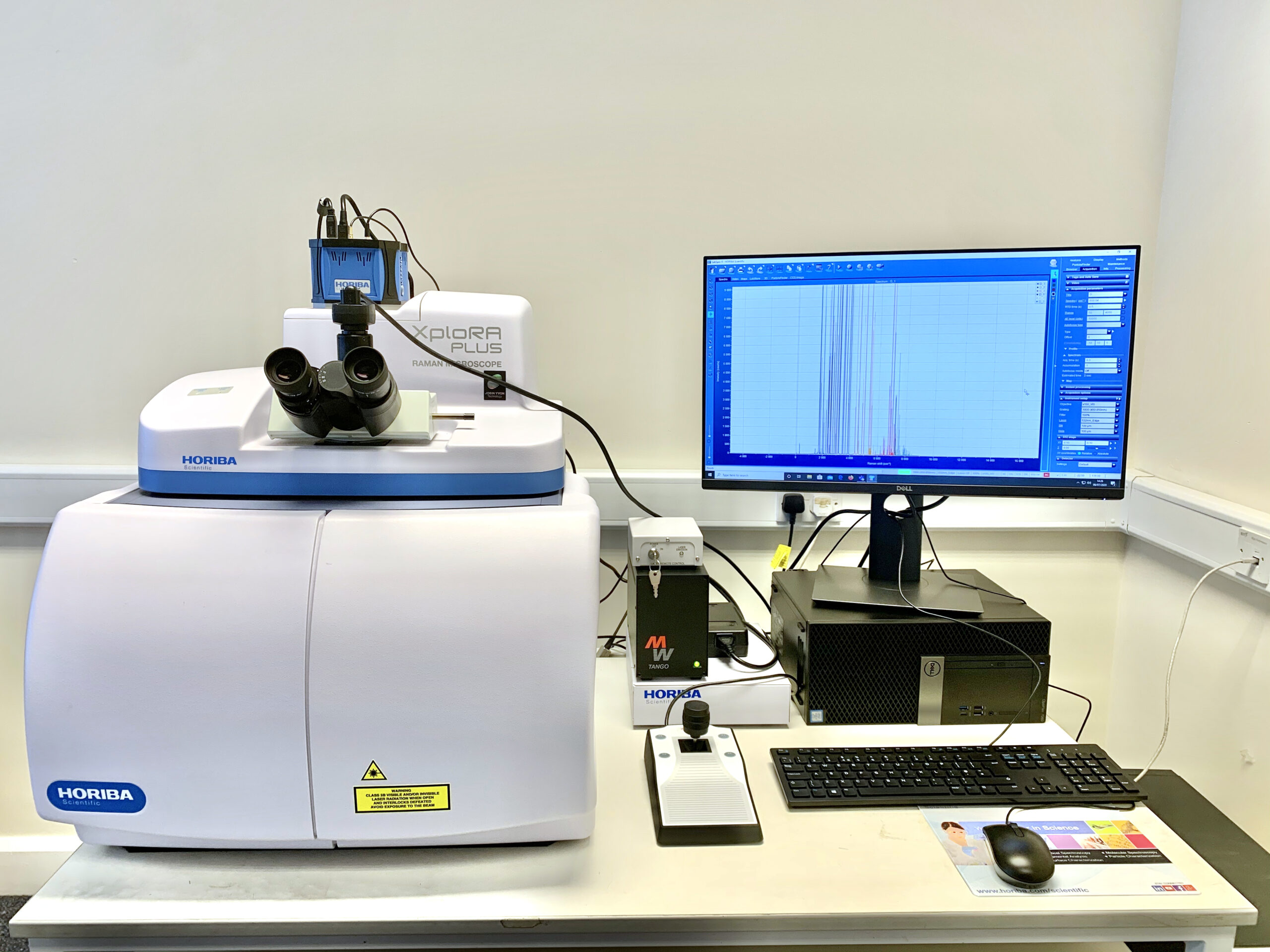
Raman spectroscopy is an automated mineral identification technique. It is a rapid, non-destructive analytical technique based on the scattering monochromatic light from a laser interacting with a molecule, causing various types of scattering of photons. In addition to its spot mineral analyser capability, our instrument is capable of automated mineral scanning and can provide and automated mineral map of a thin section.
Laser particle size analysis
We can provide laser particle size analysis capable of measuring particles from 0.02um to 2mm in a dry powder which is introduced into the instrument using wet dispersion method. Dry particle size analysis can be applied for sediments that have been dried. At present, samples are tested to identify the accuracy of particle size analysis for a range of sediments. The instrument is also equipped with a wet analysis that provides a method of dispersion for samples across a wide particle size range, ranging from sub-micron clay particles through to sands and sediments.