


X-ray Fluorescence


X-ray fluorescence
Although XRF data does not have the absolute detection limits of ICP analysis it is still vital in the inorganic geochemist’s tool box. Solid samples are analysed, which means sample preparation is minimal and quick. The benchtop instruments are robust and can be readily transported into the field, core store or wellsite. XRF obtains some elements that ICP finds difficult, especially volatile elements such as S, Cl, As, Pb. While XRF can be used in many chemostratigraphic studies it is not applicable in very ‘clean’ lithologies such as quartzites and pure carbonates; for such lithologies ICP is required.

- Lab-based or well-site options
- Major and trace element analysis
- Calibrations using matrix matched crms
- Quality control by participation in international round-robin proficiency tests
Laboratory based XRF
X-ray fluorescence (XRF) analysis provides quantitative information on the elemental composition of a sample. In XRF the sample is irradiated with radiation from a primary x-ray source causing electrons to be emitted from atoms in the sample. As the atoms return to their original state energy is released in the form of secondary or fluorescent x-rays which can be detected. Each atom produces its own characteristic fluorescent x-rays enabling us to identify the element whilst the intensity of the radiation is used to determine the concentration of each element present.
XRF is used as a tool for identification of either the major or minor/trace elements present depending on how the sample is prepared and the calibration of the XRF instrument. Our laboratory houses 2 Rigaku XRF spectrometers, a wavelength dispersive (WD) Supermini200 and an energy dispersive (ED) Nex-DE.
Samples for major element analysis are finely ground, dissolved in molten lithium borate flux and then cast into a fused bead. The bead is then analysed using our WD-XRF instrument calibrated using 52 certified reference materials. Trace element analysis is performed using the ED-XRF, the sample having been machine milled, mixed with a water based binder and then pressed into a pellet using a hydraulic press.
Both these XRF methods give quantitative data which is regularly quality controlled by our participation in international round-robin proficiency tests.
Recent advances in XRF technology have led to small hand held units. These portable units are restricted in their analytical capabilities but do enable very high resolution geochemical data down cored sections to be gathered very quickly and without any sample destruction. HHXRF units are particularly useful in shale resource plays proving rapid lithological information, facies data and a means to calculate RBi.
Benchtop X-Ray Fluorescence
Our benchtop XRF systems are fully portable, yet provide data of similar quality to larger laboratory-based instruments. They can be used to provide data directly from cuttings samples with no sample destruction in storage facilities or at well-site

X-ray Mineral Services Finland win tender from GTK
On behalf of Hafren Scientific, X-ray Mineral Services Finland (XMS Finland) is pleased to announce we have been selected by The Geological Survey of Finland (GTK) to deliver a tender entitled ‘BESPOKE GEOANALYTICAL SERVICES ON SELECTED BATTERY MINERAL-CONTAINING...

Lithium-Mica Minerals Case Study
The mica group of minerals are phyllosilicates with a common basic crystal structure. Of the 41 species currently known, we are going to demonstrate the ability of X-ray diffraction (XRD) to distinguish…
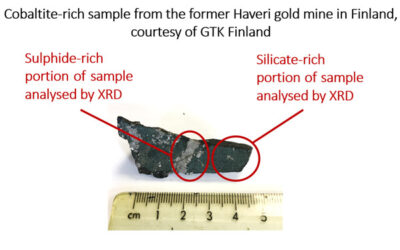
Cobaltite from Finland – A battery mineral case study
Cobaltite is a cobalt-arsenic-sulphide and is one of the primary mineral sources of cobalt. Cobalt is listed as a Critical Raw Material (CRM) by the EU because it is both crucial for Europe’s economy…