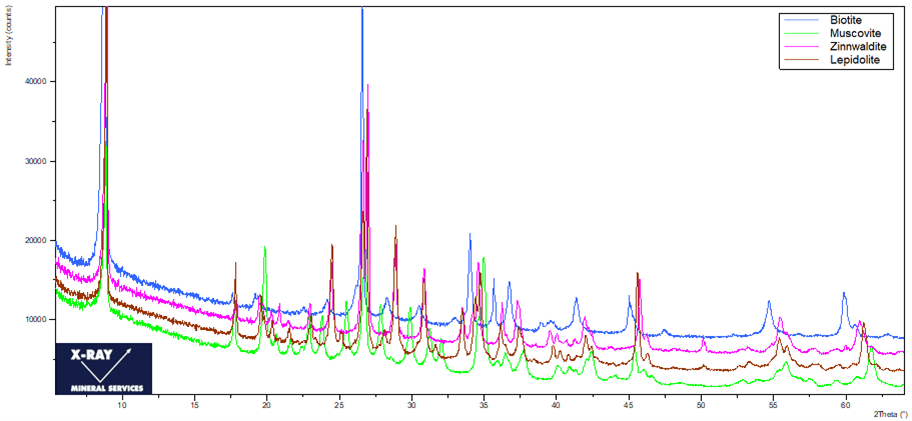
The mica group of minerals are phyllosilicates with a common basic crystal structure. Of the 41 species currently known, we are going to demonstrate the ability of X-ray diffraction (XRD) to distinguish 4 of them: muscovite, biotite, zinnwaldite and lepidolite. Muscovite and biotite are two of the more important rock-forming micas (well known to geologists), but few workers have experience of lithium mica mineral series zinnwaldite and lepidolite. These minerals are relatively rare and are often associated with geochemically-evolved intrusive granites and related pegmatites and aplites. They are important host minerals for the element lithium, a key commodity for the manufacture of lithium-ion batteries and of considerable economic interest as they can contain up to 7wt % of Li2O.
QXRD is one of the most powerful and cost-effective methods to determine the mica species in a sample using the position and relative intensity of the X-ray induced peaks in a diffractogram. Although the main peak for all mica minerals is in a very similar position, careful examination of higher end reflections helps to distinguish biotite from muscovite and the lithium-rich micas.