


Answer: When it comes from Etruria, and we are not talking about Italy here! In the latter part of the 19th century the ‘productive’ rocks of the British Carboniferous were the basis of explosive growth in manufacturing and contemporary geologists were struggling to make sense of the disparate mineral outcrops of different regions.
Marl in a strict, modern sense is a fine-grained, deep-sea sediment comprising abundant clay with a variable but significant content of carbonate, which was frequently used as an agricultural top-dressing in lieu of lime which was expensive. However, ‘marl’ has an archaic and counter-factual usage for any rock with a high clay content – mudstones in modern terminology.
The Etruria Marl was a term first used by W.Gibson in 1901 to describe an unusual and variable group of clay strata overlying the Coal Measures in North Staffordshire, and the type locality is the historical quarries near to Josiah Wedgwood’s 18th century estate, which he named Etruria in a fit of romantic enthusiasm for classic, Italian artistry. Gibson’s terminology was somewhat perverse because he went on to describe petrography showing that interbedded grits were of volcanic origin. He continued in his paper to correlate the Etruria Marl with similar facies from South Staffordshire and Denbighshire and thus set-up the basis of the Etruria Formation as known in the modern BGS Lexicon. In 1930 a paper was read at the Geological Society by T.Robertson, who revisited the correlated strata and said that there was no escaping the conclusion that the Etruria Marl was the product of denudation and weathering of the ‘Midand Basalts’. He also cited an 1877 geochemical study of brick-clays from South Staffordshire, and compared analyses of the Etruria Marl with local basaltic rocks. Modern research has concluded that the Etruria Formation is a good example of the “genesis of red beds as muddy alluvium under moist tropical climatic conditions”.
Why is it important? Only because the Etruria Formation has been the source of raw material for the finest engineering-bricks, tiles and terracotta wares that have been, and still are, produced in Britain. We will look at this fascinating resource by means of XRD and XRF to find out what makes it so useful.
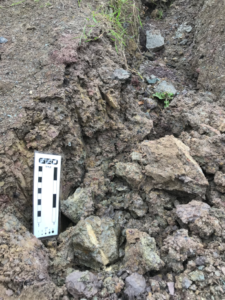 Outcrop of Weathered Clay Stockpile
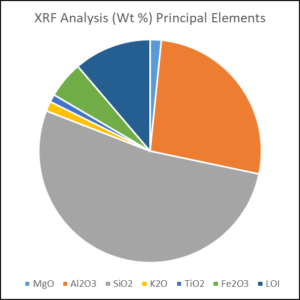
In Wales the Ruabon district was home to numerous companies producing ‘red’ or terracotta wares, but the very last of them was the Hafod Red Works brought to fame by Henry Dennis, and operating between 1878 and 2008. Stockpiles of the original clay dug for the Hafod Works are still in existence, but tiles are no longer fired at the site. XMS were granted access by Ruabon Sales Ltd. to collect samples for analysis, which makes a very useful comparison with production from several quarries now operating in Staffordshire. Separate XRD analyses of the <2 µm clay and bulk sample were performed, as well as XRF for major and minor elements.
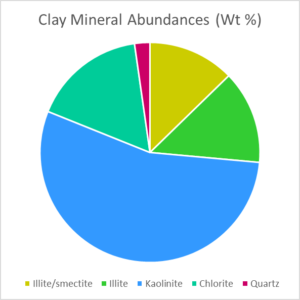
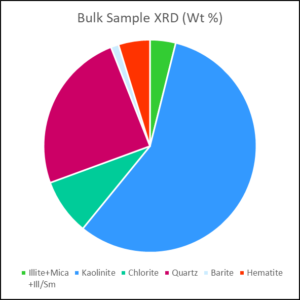
This analysis is fairly typical of the Etruria Formation, with a high kaolinite content, some illite and ordererd illite/smectite and hematite which is expected from the purple-red colour of the bulk sample. Less common is the chlorite content, which is untypical of samples of this formation in Staffordshire. Note, however that clays and quartz are the only silicates present apart from traces of feldspar.
Fired Wares
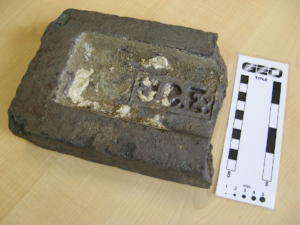 JCE Paver found on beach near Conwy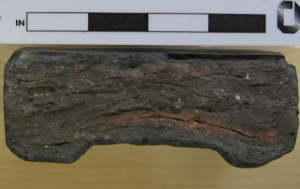
Section through JCE Paver
A chance find of a labelled, fired paving block with the initials “JCE” in historical waste tipped to combat coastal erosion near Conwy led to research into the comparative mineralogy of fired and ‘green’ products. JC Edwards (JCE) produced wares from 4 sites near to Ruabon, one of which exploited the Etruria Formation at Cefn Mawr to produce structural clay products, including paving and stable-blocks of similar dimensions but with embossed drainage channels. For this application the wares were fired at very high temperature and with a reducing atmosphere to give a blue colour and semi-vitreous surface. Blocks of this type were proposed for paving at a time when increasing traffic highlighted the woeful state of the local roads. JC Edwards had hoped to break into sales for road paving such as the 3.2 million bricks used to relay the Indianapolis Speedway in America, but local councils were impervious to his efforts apart from a 100 yard demonstration length nearby in Rhosymedre.
XRD on a powder sample of a JCE block gave the following mineral content:
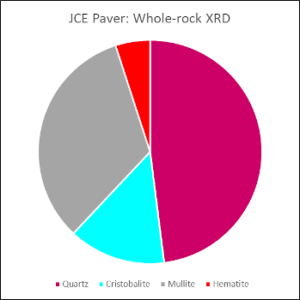
Note that, although it is a ‘blue’ brick, hematite is still a significant phase, and the red colour is still visible in the core of the product, as are the traces of pressing the clay mixture. Quartz is clearly a residual phase from the raw material, but mullite and cristobalite totalling nearly half are reaction products from the firing, which probably reached 1200 C. Cristobalite is a high temperature silica polymorph, characteristic of acid lavas, but here it is indicative of inversion from quartz at above 1100 C and crystallisation at high temperature from the liquid phase of the sinter. Mullite derives mostly from the incongruous melting of illite and kaolinite from the raw clay material. However, given the melt content of the sinter, there is probably a significant glass content in the finished ware – and that can be quantified by adding a weighed ‘spike’ to the XRD powder preparation and analysing it afresh. Subsequent Rietveld analysis will yield an overestimate of the spike abundance, which can be solved to calculate the proportion of the sample mass which was not included in the original analysis. That proportion represents the glass, or ‘amorphous’ content of the sample. The revised analysis after spiking (we used silicon, but other materials can be used) is given below, and it is clear that ignoring the amorphous part of the material would be a serious omission.
